flash usdt, a new method for creating and testing USDT tokens on ChainIDE
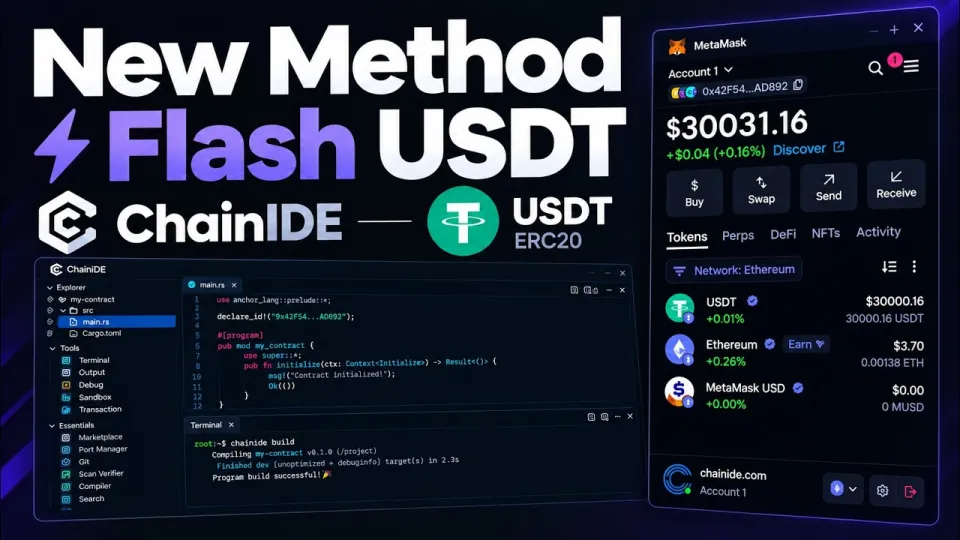
Video: Flash USDT | Found a NEW Method on ChainIDE
· based on the channel Rca FastPrint
Key takeaways
- Flash USDT involves creating USDT-like ERC20 tokens using smart contracts.
- ChainIDE is a web-based IDE for developing and testing smart contracts conveniently.
- MetaMask connects the wallet to Ethereum network for interaction and testing.
- The method covers full workflow: contract development, deployment, and wallet integration.
- Always verify contract code and addresses before any live interaction.
What is Flash USDT and How Does It Work?
Flash USDT is a method to create and interact with USDT-like tokens on the Ethereum blockchain using smart contracts. It leverages the ERC20 token standard to simulate Tether (USDT) tokens and allows developers and testers to build, deploy, and experiment with these tokens in a controlled environment. This method is particularly useful for educational, development, and testing purposes where real USDT tokens are not involved.
The process involves coding the ERC20 token contract, deploying it on a test network, and managing it through wallet interfaces like MetaMask. The key advantage is gaining a hands-on experience of token creation, transaction handling, and contract interactions without risking actual funds.
Setting Up ChainIDE for Flash USDT Development
ChainIDE (https://chainide.com/) is a cloud-based integrated development environment designed for blockchain developers. It supports Solidity smart contract development, deployment, and testing across Ethereum-compatible networks.
To start with Flash USDT:
- Register or login to ChainIDE.
- Create a new Solidity project and import or write the ERC20 token contract code.
- Use the provided ChainIDE script from the official resource (https://sites.google.com/view/defiflashusdt) to facilitate the Flash USDT creation.
- Compile and deploy the contract on an Ethereum testnet (e.g., Goerli or Sepolia).
ChainIDE’s intuitive interface shows contract structure, variables, and functions, helping developers understand the token mechanics in depth.
ERC20 Token Structure in Flash USDT
The ERC20 standard defines how tokens behave on Ethereum. Flash USDT contracts adhere to this standard, implementing essential functions such as:
- `totalSupply`: total tokens available
- `balanceOf`: token balance of an address
- `transfer`: move tokens from sender to receiver
- `approve` and `transferFrom`: delegated token spending
The Flash USDT contract mimics USDT’s properties but is customizable for testing. Developers can adjust supply, decimals, and token name/symbol. The contract also includes events for transfers and approvals, enabling wallet interfaces to track transactions accurately.
Connecting MetaMask and Interacting with Flash USDT
MetaMask is a browser extension wallet that connects users to Ethereum networks. After deploying the Flash USDT contract via ChainIDE, users can:
- Import the contract address into MetaMask as a custom token.
- View balances and send Flash USDT tokens within the wallet.
- Approve token allowances for decentralized apps or other contracts.
This integration completes the workflow from development to user interaction, simulating real-world token usage. It also enables testing of transaction flows and contract responses without real USDT.
Best Practices and Common Pitfalls in Flash USDT Usage
When working with Flash USDT or any token creation method, it is crucial to:
- Always verify the smart contract source code before deploying or interacting.
- Use test networks exclusively for trial runs; avoid sending real funds to unknown contracts.
- Double-check contract addresses and transaction details to prevent scams.
- Understand the contract’s functions and limitations to avoid unexpected behavior.
Common mistakes include deploying incomplete contracts, misconfiguring token parameters, and interacting on the wrong network, which can lead to loss of funds or inability to use tokens as intended.
Useful Resources and Tools
- ChainIDE official site for development and deployment: https://chainide.com/
- Flash USDT script and documentation: https://sites.google.com/view/defiflashusdt
- MetaMask wallet for Ethereum interaction: https://metamask.io/
Итог
Flash USDT offers a practical approach to creating and testing USDT-like ERC20 tokens using ChainIDE and MetaMask. This method empowers developers to understand smart contract workflows and token mechanics safely and efficiently. By following the outlined steps and best practices, users can explore decentralized finance concepts and smart contract interactions with confidence. For a detailed walkthrough and further insights, refer to the "Rca FastPrint" channel, the original source of this method. To begin your Flash USDT journey, visit ChainIDE for free registration and access to development tools.
Полезные ссылки
- ChainIDE: https://chainide.com/
- Flash USDT Script and Documentation: https://sites.google.com/view/defiflashusdt
Source: Flash USDT | Found a NEW Method on ChainIDE · Markdown version
Questions & answers
What is Flash USDT and why is it useful?
Flash USDT is a method for creating USDT-like ERC20 tokens on Ethereum test networks, enabling developers to practice token creation and interaction without risking real funds. It’s useful for learning, testing, and development purposes.
How does ChainIDE facilitate Flash USDT development?
ChainIDE provides a cloud-based integrated development environment where developers can write, compile, deploy, and test smart contracts like Flash USDT tokens efficiently, without setting up local environments.
Can I use Flash USDT tokens in my MetaMask wallet?
Yes, after deploying the Flash USDT contract on a testnet, you can add the token to MetaMask as a custom token, view balances, and perform transactions within the wallet interface.
Is it safe to interact with Flash USDT contracts on the Ethereum mainnet?
No, Flash USDT is intended for educational and testing purposes on Ethereum testnets only. Interacting with unknown contracts on the mainnet can be risky and may lead to financial loss. Always verify contract details and use test networks for experimentation.